Sustaining Teacher Leadership of Professional Learning through Lead by Learning’s Gradual Release Model
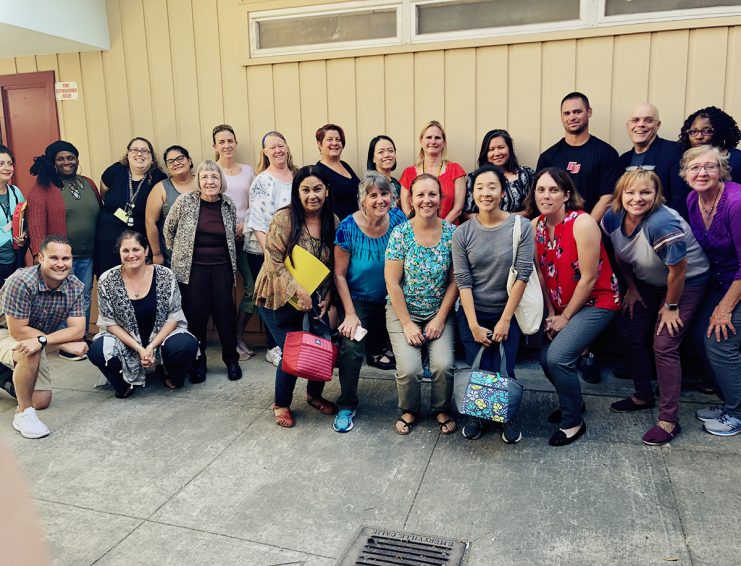
At Lorenzo Manor Elementary School in San Lorenzo Unified School District, a powerful story of teacher-led professional learning has unfolded over the past ten years. What began as an effort to build coherence and collaboration has become a sustaining feature of the school’s culture—anchored by a consistent inquiry structure, teacher leader vision, and protected time for shared reflection. From 2016 to 2021, Lead by Learning supported Lorenzo Manor through a gradual release model, intentionally shifting responsibility for professional learning design and facilitation to the teacher leader team. Since 2021, the team has sustained and strengthened these structures on its own, transforming the school’s culture of adult learning and collaboration.
Teacher-Led Inquiry at Lorenzo Manor
This past school year, drawing on their years of support from Lead by Learning to identify an umbrella focus for the teacher inquiry community, the teacher leader team at Lorenzo Manor identified reading mini-lessons as the highest-leverage focus for professional learning. Their goal was to support teachers in using the adopted curriculum not as a script, but as a resource for designing mini-lessons grounded in essential standards. Early in the year, teacher leaders modeled how to do this using the provided curriculum alongside teacher-created materials to build mini-lessons that aligned with priority standards. The emphasis was never on compliance. Instead, the teacher leaders communicated a clear message: teachers have agency to decide how to use the curriculum, and we want everyone to make meaningful use of it when it supports student learning.
A Culture of Public Learning and Reflection
As the year went on, Lorenzo Manor teachers were invited to engage in Public Learning, one of Lead by Learning’s signature practices, modeling not just successful lessons but also sharing challenges and problems of practice alongside real-time student learning data to invite multiple perspectives on their instruction. Over the past two years, all but two staff members have served as Public Learners, a strong indicator of the shared commitment to teacher-led learning across the staff.
In facilitating professional learning, the teacher leaders rely on a set of collaborative building blocks that Lead by Learning supported them to weave into the fabric of teacher inquiry early on, and that have now become second nature to leaders and teachers alike:
- Opening and community building
- Revisiting the year’s inquiry trajectory
- Purpose setting and framing
- Supporting the Public Learner
- Individual reflection via a “Think Alone” with prompts to guide analysis of student learning data and instructional effectiveness
- Small-group conversations across grade levels to support shared sensemaking about teaching and learning
- Grade-level synthesis to concretize next steps
- A closing reflection
Teacher leaders rotate facilitation responsibilities. Each person plays a role in the session’s preparation, from creating the slide deck to sending email reminders to staff. As one teacher leader put it, “The talking points are now comfortable. … At the beginning, we needed help to figure out what to say. Now it’s familiar.”
Sustaining Vision Through Change
The continuity of this inquiry structure is no accident. Former principal John Shimko laid a strong foundation during the school’s partnership with Lead by Learning, allocating two hours of stipended design time each month for teacher leaders to prepare for teacher inquiry meetings. He also shifted the staff meeting structure so that every other meeting would be devoted to inquiry. After the partnership concluded, and even through Principal Shimko’s recent absence due to medical leave, the inquiry work continued without interruption because these essential structures were in place.
“This is the one thing we’ve continued,” says teacher leader Justin McJilton. “There have been so many things changing. Initiatives come and go. We need one thing to carry on.”
That consistency has proven vital, especially through district shifts, staffing changes, and a global pandemic. The inquiry structure has flexed over the years to center on different content areas in response to student data trends and district priorities. Next year, teacher leaders anticipate adapting once again to align with a new curriculum adoption focused on the science of reading.
From Compliance to Commitment
Teacher leaders reflect that early participation in inquiry felt more like checking a box. Teachers would scramble to grab student data samples just before meetings. Now, the majority of staff are thinking deeply about their inquiry questions, tracking impact over time, and bringing meaningful artifacts to share.
“Don’t focus on the lemons, focus on the lemonade,” says teacher leader Rosie Sandoval when asked what they’ve learned over the years. While a small handful of staff still aren’t fully engaged, the culture has shifted so significantly that their disengagement feels like the exception—not the norm.
The teacher leaders are also looking ahead. They’re beginning to ask: How do we know mini-lessons are strengthening reading independence and deepening student thinking? Next year, they plan to reintroduce a practice of partnering with focal students to help their colleagues track that progress.
The Takeaways: What Makes This Work Endure
The story of Lorenzo Manor is one example of how Lead by Learning’s partner schools sustain teacher leadership of professional learning through a gradual release model. Key ingredients include:
- A clear vision for collaborative inquiry that both principal and teacher leaders articulate consistently
- Shared leadership and design, with teacher leaders owning all aspects of facilitation
- Protected and compensated time to plan and prepare (at least 2 hours/month)
- A familiar and consistent structure, so staff can focus on learning, not logistics
- Public Learning that builds and maintains a culture of vulnerability, trust, collective responsibility, and curiosity
- An expectation that student learning data will be on the table at every inquiry meeting
- Adaptability to evolving school needs and district priorities
- An unwavering commitment to adult learning as a lever for improving student learning
Lorenzo Manor’s journey shows what’s possible when teacher leadership is cultivated, trusted, and resourced. As one teacher leader put it, “We are capable of sustaining something important at Lorenzo Manor.” Lead by Learning is proud to have supported these remarkable educators to build the mindsets and practices that sustain a robust culture of collaboration in service of their vision for student success.
In October 2025, Lorenzo Manor teacher leaders Ashley Thomsak and Deja Escalera shared their story and celebrated 10-years of Inquiry at Lead by Learning’s Inquiry in Action Forum. Watch their story.