Cultivating Reading Identities Among High School Students
Though I sit in a room full of books brimming with knowledge, prose, and storytelling, I found that my students tended to ignore these materials and only engage with the social aspect of the school library as a community space. This was the foundation of my inquiry: how do I encourage my students to opt in to reading?
As the librarian at Tomales High School in Shoreline Unified School District, my question began in September as a desire to reframe perceptions around reading and encourage students to use library resources. I selected a handful of focal students, with a range of interests and reading levels, and examined their circulation reports. While this data was informative, it was limited. All I knew was how often my students were checking out reading materials and the kinds of materials they were selecting. Almost immediately, I felt stuck. How do I figure out the why?
Turning to my colleagues at Tomales High School, within the structure of our data review meetings supported by Lead by Learning, I shared my frustrations. While I was met with empathy and understanding, I was challenged to reevaluate my angle of investigation. I learned that my initial question seemed more focused on the library rather than the students; I was more focused on making library resources more interesting, instead of focusing on how my students feel about reading. I had a newfound desire to understand my students’ self-identity as readers and how misaligned identity in readership may impact how my students engage in literacy behaviors.
In response to this goal, I designed and deployed a survey that was sent to all students. This survey was designed in three parts:
- Literacy Behaviors & Environment
- Identity & Enjoyment
- Book Club Interest
While many interesting insights were revealed within this survey, the data that most aligned with my inquiry goal was unveiled within a few very specific questions.
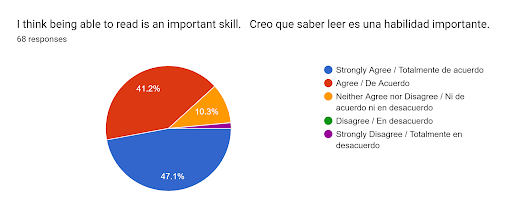
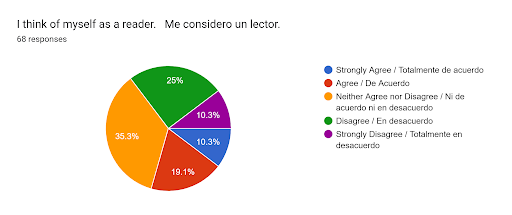
The dichotomy of the results of these two questions was astounding. A wide majority of students think reading is an important skill, but less than a third see themselves as readers. Where is the disconnect between these two sentiments?
My initial thought was that students may be agreeing with reading being an important skill because they think it may be the “right” answer. However, when I inspected how students interpret being a “reader,” I realized the answer is much deeper.
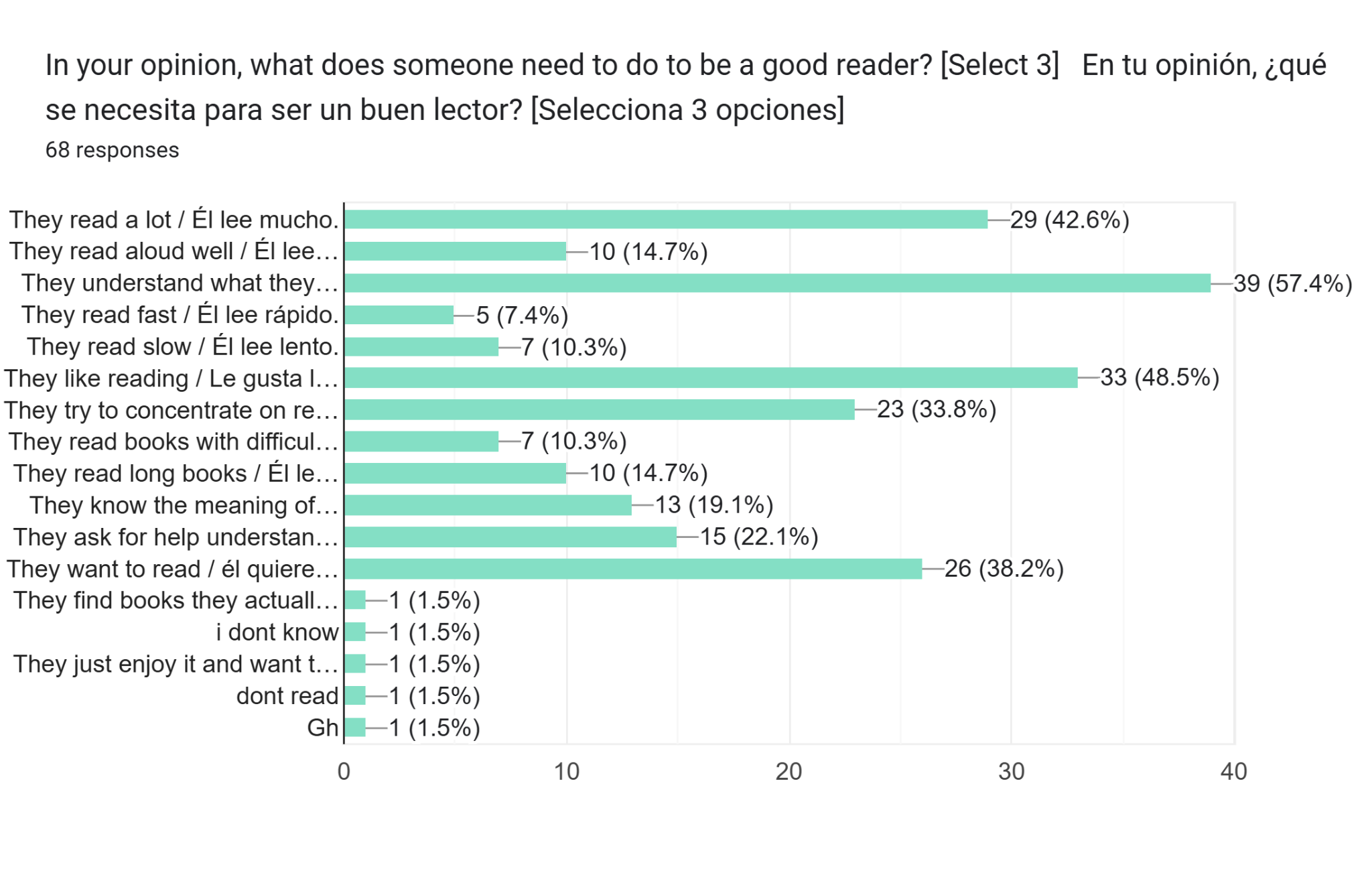
In response to being asked to select qualities of someone who is a good reader, the top three responses were:
- They understand what they are reading. (39 responses)
- They like reading. (33 responses)
- They read a lot. (29 responses)
Both comprehension and enjoyment were selected at higher rates than any other quantitative characteristic. Therefore, since my students are not identifying as readers, are they not comprehending or enjoying their reading experiences? If students do not have positive reading experiences to draw from, then maybe they are less likely to identify as a reader and less likely to engage with new reading material?
For the rest of the inquiry cycle, I decided to really hone in on the enjoyment portion of reading. In collaboration with an English teacher, we started a book club in March, which grew to over 10 members by the end of the year. As advisors, we utilized this data to our advantage. Instead of choosing a book to read as a group, we wanted to help our students make positive associations with literacy behaviors. For example, during one meeting, we started listening to an audiobook while eating lunch and decorating bookmarks.
Additionally, this work has informed and influenced the way I approach reference. All students in Freshman and Junior English classes are required to do independent reading throughout the year. In the months following this Readership Identity Survey, I tested out a slightly different reference tactic. While I have always asked students what they enjoy reading, watching, or listening to, I was usually met with “I don’t know.”
I decided to ask them to tell me the last time they enjoyed reading something, if ever, and to try to describe what they liked about it. Did they enjoy the characters or the setting? How did they react while reading it; were they scared, sad, mad, or happy?
If my students report never having an enjoyable reading experience, I refer them to a list of books that are either quick reads or that many students report enjoying. The ultimate goal is to provide students with an opportunity to scaffold their identity as readers by ensuring that they find some element of enjoyment. With more positive reading experiences under their belt, it is my hope that they will be more discerning with negative reading experiences. Instead of saying they don’t enjoy reading as a whole, they may be able to pinpoint that they did not like the genre, a character, or some other element. In continuing this work, I will be centering my inquiry on facilitating more opportunities for students to create enjoyable reading experiences.
As an early career librarian, this work has been deeply impactful in learning how to apply data to practice. Having the space to examine different data sources and to try different interventions made my learning more meaningful, as I was allowed to reframe and reevaluate my approach in a structured, safe environment.
For others looking to take an inquiry stance in their practice to best support students, remember that the journey will be nonlinear, but reframing ideas will be essential to identifying the core of the surfaced issue.
Abrielle “Abby” Spaletta is the Librarian at Tomales High School. She received her Bachelor’s in Cognitive Science and Psychology from UC Davis in 2022 and recently received her Master’s in Library and Information Science from San Jose State University in 2025. Abby serves as a member of the Data Review Design Team and as secretary on the Site Council. Additionally, she works with Bridge the Gap College Prep to provide after-school tutoring services in math. When not in the library, Abby enjoys going to ballet class, playing cozy video games, and cuddling with her cat, Spumoni.
Interested in partnering with Lead by Learning to build the schools students need? Connect with a member of our team to learn more about our range of partnerships designed to reach your goals for student and adult learning.