

A Key Lever for School Change: Developing Teacher Leadership
Every school has them. A group of teachers who go above and beyond, the ones who sign up for all the committees, run the extracurricular programs, volunteer to be the teacher representative at the Parent Teacher Association or School Site Council Meetings. They are often the teachers that others turn to for advice. While many schools identify these individuals as teacher leaders, far fewer schools have figured out how to support these teachers to strategically lead instruction school-wide in official capacities.
For the past two decades, Lead by Learning has partnered with districts and schools to develop teacher leaders and transform the Instructional Leadership Team into essential levers for school change. Our work has shown that this transformation rests on three key components:
- identifying the school’s instructional vision with teacher leaders,
- developing teacher leader identity, and
- redesigning school-wide adult collaboration so teacher leaders can drive effective instruction school-wide.
Identifying the Instructional Vision of your School with Teacher Leaders
The following statements are indicative of the types of statements we often hear from teacher leaders while engaging in a listening campaign at the start of our partnerships.
“We are focused on math because it is a district mandate.”
“Who knows what our priorities are this year? They keep changing with our new leadership.”
“It’s the school’s goal of the month, but that’s not my goal.”
Teachers often feel a lack of agency when it comes to identifying learning priorities for their school because they are often decided without them. That lack of agency can translate to confusion, disconnectedness, and frustration. That’s why we work with Instructional Leadership Teams and site leaders to make sense of district-wide goals collectively and think about their school-wide goals within that in order to chart a path that can achieve both goals and stay deeply rooted in their classroom realities. When principals and teacher leaders develop an instructional vision for their school, together, it allows them to use that vision to evaluate where, when, and how they use their precious time, energy, and resources. No longer is the site principal alone making decisions and evaluating progress, but the whole Instructional Leadership Team is on board.
This collective vision enables them to focus on instruction and student outcomes, rather than the variety of issues that inevitably arise, and strategically plan for effective instruction to address learning loss, support their most marginalized students, and accelerate learning for all students. The instructional vision provides a road map for decision-making, budget prioritization, and classroom practices. School change happens when the whole school is on board, and true buy-in and collective action can only happen when teacher leaders are brought in at the start.
Developing Teacher Leader Identity
Teacher leaders are rarely self-identified. These teachers are almost always identified by other teachers or their principal. They are tapped to support the school in numerous ways, and agree to do so because they are usually student-centered and want to see their school thrive. Despite all that, they don’t always see themselves as leaders or feel comfortable in a leadership role, or the instructional leadership role that their site leader is hoping they’d step into. Participating in creating an instructional vision for their school is one of the first steps to seeing themselves as instructional leaders. This process allows them to share their hopes and dreams for students, to think about best practices, and to identify shifts that are needed in order to pursue this vision. It is the beginning of developing their teacher leader identity as instructional leaders. Once this vision is established, teacher leaders often feel greater clarity about their role and are invested in supporting other teachers to engage in achieving the instructional vision because they were part of the design process. The vision did not happen to them but with them.
However, one moment to construct a vision is not enough. Cultivating teacher leader identity happens over time for teacher leaders to feel the same kind of confidence in leading learning for their colleagues as they do leading learning for their students. This includes developing their practices and mindsets simultaneously for leading adult learning. While some practices might be technical: crafting agendas for their team meetings, learning and utilizing protocols for how to facilitate collaborative conversations with their colleagues that ensure equity of voice, others are more adaptive, like supportively challenging one another to ensure that the right discussions are taking place and staying focused on instructional strategies in service of student success. Creating time and space in ILT meetings to tend to these practices and mindsets is central to the teacher leader’s development.
After facilitating two Professional Learning Community (PLC) meetings, one teacher leader was frustrated because she felt like she had to have all the answers, and if she didn’t, she didn’t feel confident facilitating. She held deeply to the mindset that teacher leaders or facilitators of learning had to be “experts.” In the Instructional Leadership Team space, teacher leaders explored this mindset to help her realize that her colleagues could figure out solutions to the complex questions they were holding on their own. They realized that they just needed time, space, and support within the group to ask questions that might help shift their thinking towards a solution. This shift enabled her to feel more secure in her identity as a leader.
With attention to these mindsets and practices, teacher leaders begin to reimagine what a strong leader can look like, and they learn how to make it their own. As their identity forms and their confidence builds, the site leaders are no longer isolated, leadership begins to distribute, and the goals for school change are dispersed.
Reimagining Adult Collaboration School-Wide
It is at this point that many instructional leadership teams realize that one of the most important shifts that needs to take place is adjusting adult collaboration spaces, so that teacher leaders truly have a space to lead instruction and put their co-constructed vision, shifting mindsets, and newly developed practice and skills into practice. For many schools, this means thinking beyond grade-level and department meetings, and thinking about different ways to group teachers, new protocols or practices to implement that encourage discussions about instructional practices, and strategies for bringing data to the conversation to see if their efforts are leading to the student outcomes they want.
While the amount of time allotted for adult collaboration varies from school to school, a pattern we have seen working in different schools and districts, is while teachers meet often, when they meet there is very little to no time for high-impact collaboration where teachers look at student data, think about their instructional strategies and talk with their colleagues about challenges they are facing and how they might address them. The power of the teacher leader to impact school change relies on their ability to lead instructional, not operational, spaces for colleagues so that they have spaces to authentically bring the school vision and goals to life and make the change they all want to collectively see tangible.
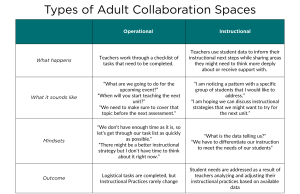
Once a school identifies a need for a different type of adult collaboration space, the teacher leaders can play a pivotal role in facilitating the space. Once teacher leaders are invested in the school-wide instructional vision and understand the importance of collaborating with their colleagues to achieve that vision, they are primed and ready to think about how to use that knowledge to lead this new type of adult collaboration. We support teacher leaders to think about the mindsets and practices that need to be developed in these spaces.
At the end of the year for one of our elementary school partnerships, a teacher leader described how modeling vulnerability about her practice transformed her team and their ability to collaborate about instruction. After she opened up at a previous meeting, another veteran teacher felt safe admitting that her approach to behavior management wasn’t currently working and that she wanted to explore new strategies. That moment of honesty, the teacher leader noted, made the whole team more willing to share struggles and ask for help and move their collaborative space from operations to instruction. Since the school identified a need for a different type of collaboration space and invested in their teacher leaders to lead it, change was possible. This reflects a broader pattern: when teacher leaders model vulnerability instead of projecting that they have all the answers, they free their colleagues to admit uncertainty and experiment with new ways of supporting students. The result is a virtuous cycle where the more open teachers are to share their struggles, the more willing they become to try new instructional approaches for their students, resulting in improved student outcomes and experiences.
Investing in Teacher Leaders is a Key Lever for School Change
We know our schools were not set up for all students to succeed, yet it is our moral imperative each day to change that and close the opportunity gap for our highest need students. To ensure school change and transform outcomes for students, we need to invest in and partner with our teacher leaders in intentional ways.
The process of identifying your school’s instructional vision, developing an instructional leadership team identity, and reimagining adult collaboration is not always smooth, straightforward, or easy, but investment in the process will pay off in numerous ways and for many years to come. Principals we have supported through this process have reported a sense of relief around not feeling the pressure of making key decisions on their own, and having a team of teachers to share ideas with and get feedback from, and the generative power of collective efficacy it creates school-wide.
Once these three components are in motion, along with ongoing support and development, teacher leadership will no longer be a goal; it will become a reality. The instructional leadership team may shift over time, with new members or different principals, but the vision, purpose, and adult collaboration can remain. Teacher leaders will understand that there is no one right way to be a teacher leader, just as there is no “right” or “perfect” way to be a classroom teacher as long as they are showing up for their colleagues in support of the school-wide instructional vision and in service of students. Without teacher leadership, schools will continue to struggle to adapt to the ever-changing educational landscape and meet the diverse needs of their students, which is why it is a key lever for school change that needs to be prioritized and cultivated.
Interested in partnering with Lead by Learning to build the schools students need? Connect with a member of our team to learn more about our range of partnerships designed to reach your goals for student and adult learning.