
Revamping Professional Development with Inquiry & Our Highest-Need Students at the Center
Where We Began with Assistant Principal Bianca Lorenz
It was a new school year, and I was returning as an Assistant Principal and facilitator of our professional development (PD) planning. In the first meeting of the year, I asked “What do we want out of PD?” Someone said they didn’t want it to be “soul-sucking”. We laughed, but we also held on to that as the sole component of what this team was trying to achieve.
As educators, we have all been in a meeting or professional development that felt irrelevant, could have been an email, or just wasn’t actually that helpful. The purpose of PD is to be “professionally developed”. As our school site demographics were changing and we saw a significant increase in our newcomer student and Long Term English Language Learner ( LTEL) population, we needed to start thinking about how we can serve our students best. I also realized I wasn’t the one to lead this conversation, as it had been years since I had been in a classroom, and I never taught this many newcomers in a single class. I wasn’t the person to lead – our teachers were.
As we embarked on this journey to revamp our professional development, we did a lot of trial and error to see what was most impactful for instructional practice and was soul-enriching for educators. In our first year, PD served as a “responsive” space, with each session responding to a need. When we saw colleagues needed support with Newcomers, we gave them a PD on teaching Newcomers. When educators could benefit from improved Content Language Objectives, we gave them a PD on Content Language Objectives. The list continued, and it felt exhausting with little to show for because there were so many needs (as there always is)!
A moment shifted, however, when several team members suggested grounding the inquiry cycle, as they had previously participated in Lead by Learning’s programming and were strong advocates for the process. What better way to make PD not soul-sucking than to make it driven by something the teacher is personally interested in to improve for students?
Our teacher leaders took it upon themselves to begin a Student Talk-centered inquiry cycle with our staff. But wow, Lead by Learning had made it look easy when we were participants. There were multiple factors that went into initiating cycles, and by the end of the year, we felt we hadn’t necessarily achieved consistency or buy-in for the inquiry. We needed help! One of our teacher leaders applied to the LIGHT awards, which grant Bay Area educator teams funding for a professional learning project, and we were fortunate enough to receive a grant to support our Student Talk inquiries and our teacher leadership with a partnership with Lead by Learning.
Empowered as Teacher Leaders with Department Head Courtney McGuire
Since then, our Professional Development team, which is made up of department heads and an administrator, has been working with a Lead by Learning facilitator to become teacher-leaders capable of guiding our staff through student-centered, data-driven inquiry. For me, as a teacher-leader, it’s been a big learning curve, but it’s had a huge payoff. In my classroom, I’m seeing students talking more and more using protocols that I’ve developed or gleaned from staff through the All Staff PDs that we’ve designed. In my department meetings, I have real autonomy as a leader and can shift our agendas day-of to best suit our needs to work towards our inquiry goals.
One particularly exciting thing this year was seeing other staff members, not just our Professional Development team, step up and share bits of their classrooms during our PD. In our planning meetings, time and time again, we’d discussed giving teachers the opportunity to observe each other teach, but the logistics of getting teachers out of their classrooms and into another classroom can be difficult. We decided to bring each other’s teaching to our All Staff meetings through short clips of specific student talk protocols and teachers engaging in Lead by Learning’s Public Learning practice in front of their colleagues. We highlighted multiple teachers, from all disciplines, both those who were department leads and those who are not, throughout the year. Each teacher brought examples of their teaching practices, questions they were grappling with, and an openness to learning from their peers. This practice shifted the culture of our professional learning immensely.
Sharing your teaching practice feels vulnerable; it’s difficult to share something that doesn’t necessarily feel perfect with peers, especially as adults who are responsible for endless tasks day-to-day. It takes courage to stand in front of your colleagues and share your own struggle, but it is also extremely comforting and inspiring. The discussions teachers had after watching videos of each other’s teaching empowered them to think about what they could take into their classrooms and try! Teachers went on to implement these strategies. When we see another teacher trying the strategies discussed on video, we cannot fall into the common equity trap of “that wouldn’t work in my class” because the students in the video are often our own students, so we know it is possible.
Visible Impact for Staff and Students
Over the past year, we received feedback from our staff on professional development, and we have seen positive outcomes so far.
Teachers rated their professional development experience higher than ever before, and a colleague shared, “I appreciated the time that our very own educators took to be a part of this. It felt warm, and like our school is really working hard to be a team.”:
Beyond being satisfied in our professional development, educators also felt that they grew their own instructional practice and were “professionally developed!”
Educators shared:
- “After PD’s I was excited to try the strategies/suggestions my team recommended. It also helped me ask more questions and see things in a new way. I was also more willing to stick to things that were not moving as fast as I needed them to. So, I definitely learned to have more patience.”
- “I’ve tried a lot of new things that I’ve learned directly from my peers, and it’s helped me grow a lot in getting kids to work together in groups and make meaning!”
- “I admired everyone’s vulnerability… even though this is something I would like to work on more as a group ( I am so shy to share out), I felt that it was important to hear from others. I also enjoyed working with new people. Even though meeting new staff is not easy, it is so important for all of us to know each other and build positive relationships. We all have a gap we need to address, and that involves students whom we all teach. So, building those relationships with staff is a must, even if you do not all get along. Our purpose is to make sure our students experience joy and are growing along the way.”
Seeing this data reminds us that we need space to share what’s working, what’s hard, and strategies that are effective and manageable. It’s helpful to see colleagues who are in the building working alongside you, trying new things, because we all want to serve students most effectively. Most importantly, it needs to come from teachers.
We’ve also seen some student growth as well.
We reduced the number of students who scored “developing” on the speaking section of the ELPAC from 28% to 25%. And, about half of the students met or beat their growth goal on the i-Ready! This level of i-Ready growth highlights the number of students who have made expected or greater-than-expected progress to move toward grade-level proficiency, which is one of our SPSA goals and is significantly important for our students’ preparedness for college and career success.
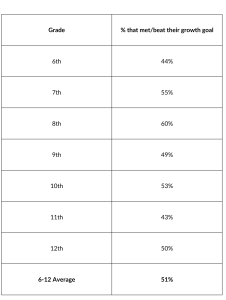
i-Ready growth illustrating the percentage of students who made expected or greater -than-expected progress towards grade level proficiency.
This data and impact have been an empowering start to understanding how collective efficacy as a school-site can start to move the needle on outcomes for our students. We have been most excited by the culture shift we have seen throughout the school site and adult learning. Over the past three years, our biggest learnings have been:
- As a leader, it is critical that we create spaces where educators feel enriched as professionals! So much of our day is engaging with youth (which we love), but it also feels really good to be treated like an expert in your field!
- All wins are deserving of recognition! We have made it a point to celebrate all points of growth in student and staff data, which helps to build camaraderie and escape from deficit ideology.
- Inquiry cycles are a wonderful, versatile tool to utilize in professional development! They enable conversations that allow educators to act as experts (see above). Even with an overarching professional development focus (like student talk), they can tailor to an individual’s needs in their unique classroom setting. They make creating next-day-next-steps possible, which is immensely valuable to an efficiency-minded staff.
As we head into next year, we are focusing on a shift to writing and expanding our PD team to include more teacher leaders. This work is only effective when we do it together, and we are grateful to have amazing staff who are willing to be vulnerable, take a learner stance, and hold high expectations for students and one another!

Bianca Lorenz is currently the principal of Madison Park Academy 6-12, where she has worked for the past 12 years as a teacher, work-based learning liaison, pathway coach, and assistant principal. She is driven by creating conditions for culturally responsive teaching and learning for all students and staff. In her free time, you can catch her knitting with her cats or on the next adventure, traveling with her husband!
 Courtney McGuire has been a science teacher at Madison Park Academy since 2021 and has been the head of the science department there since 2023. She earned her Bachelor’s Degree in Integrative Biology and Master’s Degree in Education from UC Berkeley. When she’s not teaching, you can find her spending time with her family, exploring the outdoors, and reading!
Interested in partnering with Lead by Learning to build the schools students need? Connect with a member of our team to learn more about our range of partnerships designed to reach your goals for student and adult learning.