No Two Libraries Are Alike: How Our District Leadership Team Differentiated Adult Learning to Improve Student Independent Reading
The 2025/2026 Library Leadership Team (LLT) for Oakland Unified School District first met on a warm August day at Northeastern University Oakland with Lead by Learning, equipped with printouts of district-wide library circulation data, some highlighters, and a peaceful breeze. While we were warned not to focus too closely on the data from our work sites, I remember looking at the data from the high school where I work and feeling a little burst of pride. Yes, our circulation could be higher, but we had just completed our first year of being fully open after being closed for over a decade. Going from zero circulations to more than 1,600 was no small feat!
I also remember a colleague, completely well-intentioned, expressing shock that circulation for high schools was so low. In 2024/2025, elementary schools reported 398,828 circulations, while high schools only reported 6,393 circulated books. Her surprise was meaningful information. Through these initial conversations as a team of librarian leaders, we identified some of the differences in our sites— position funding, types of books being circulated, site resources, family involvement, day-to-day structure, and even the years the library had been open. This led us as leaders to ask: How could we create meaningful learning experiences that respected these differences? How could we grow as librarians with an intentional equity-focused lens?
Goal of the Year
As a team, we were tasked with providing adult learning for 65+ librarian staff. The colleagues I would be supporting worked at different school sites, with different communities, different grade levels (elementary through high school), and held different jobs within library contexts. I knew that I wanted our shared professional learning to be sensitive to these differences and empower my colleagues to thrive in those different contexts.
Thankfully, we had a powerful throughline. Our focus for the year was to build students’ independent reading, and we defined this as building student agency in selecting and reading books in August with Lead by Learning and began to set our vision as a leadership team. As library staff, we want to foster literacy and joy with reading. Our goal is to make sure that, regardless of context, students within our district have access to libraries and access to joy. How could we help our staff engage in a cycle of inquiry around this goal, given different experiences and contexts?
Key to Differentiation: Discovery Groups
Students have complex needs, and so do their schools. At library professional development (PD) in the past, I spent a lot of collaborative work time explaining my context, unable to get to the more substantive work and deeper collaboration. Acknowledging differences and honoring both our distinct challenges and strengths felt important to me to make sure folks feel safe to learn, and I wanted to allow us to experience deeper collaboration and learning with each other. As an LLT, we identified three ways to set up our learning to meet that goal:
1) Simple framing activities to acknowledge our different contexts.
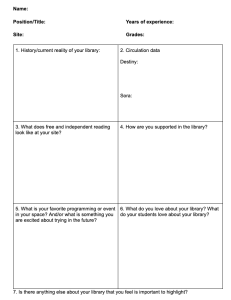
Figure 1: Our framing activity; “Library Profiles.” We wanted to provide a space to acknowledge and think about contexts, but also to celebrate the assets of our communities.
2) Consistent and intentional groupings.
We had at least two leadership members in elementary, middle, and high school positions and saw an opportunity to co-lead Discovery Groups to explore our inquiries. Giving time to work in smaller groups would help make this work more approachable and meaningful. I co-lead the “High School” Discovery Group. High school has the fewest library staff, some of the newest library staff, and the most recently opened libraries. Our small group allowed us to try different things and be responsive to our needs.
3) Starting with visioning. What would our libraries look like with a thriving independent reading culture? Just as we did internally with LLT in August, we needed to spend time with our goal before getting caught in the weeds of day-to-day challenges with our colleagues.
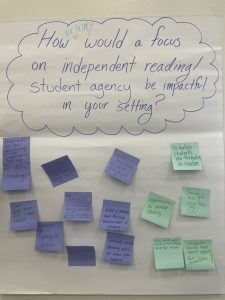
Figure 2: One of our visioning activities, completed with the High School Discovery group to capture initial understandings.
I encouraged our colleagues to have fun drawing how they envisioned independent reading happening in their library. The imagination and hope of the library as a joyful space felt important to revisit at the start of the year and served to frame our work around the assets of our community.
Once the learning was set up, it was important for us to look at relevant data in our High School discovery group. What did the evidence show us about independent reading? While circulation data is a helpful snapshot, it felt inadequate for our small group, given the complexities of our contexts. We wanted to more intentionally solicit student voice. We wanted to interview students.
This kind of inquiry and data source was new for many members of our group. We also chose to support colleagues by providing simple questions they could ask students about their relationship to independent reading. I modeled the interview by bringing in a recorded interview that I conducted with a student and led the group through a listening protocol. This was an immediately valuable and engaging learning experience! While listening, my colleagues immediately noticed things that I wouldn’t have as someone who knew the student.
By having colleagues bring in recordings or quotes, we were able to share yet another unique facet of our work and contexts. Even folks who were not able to conduct an interview this year engaged meaningfully in our analysis of the data and expressed a desire to conduct an interview in the future. Over the course of the year, we continued to check in with student interviews and learned that even students with “healthy” reader identities were not necessarily reading as much as they wanted to. Even if they felt positively about reading, our readers felt they did not have time or gave themselves a hard time for not prioritizing reading as a pastime.
Impact
When the school year ended, we returned as an LLT to where we started in August with Lead by Learning. In terms of circulation data, high school checkouts continue to rise overall (from 6,393 to 10,367, with two books in the collection per student), but we still have a lot of ways to grow. Not every site increased circulation. Interestingly, some sites at other grade bands actually went down– intentionally. A benefit from the Discovery Group differentiation is that some elementary and middle school librarians identified a problem unique to their contexts: that some students were checking out more books than they could read, or grabbing books because it was an expectation. In order to focus on more intentional reading (student agency), some staff made switches, such as going from allowing five checkouts to three checkouts to emphasize quality checkouts over quantity. Elementary went from 398,828 to 349,226, and middle school went from 38,869 to 35,389, but library staff reported feeling happy with the intention they were able to build in their contexts.
The lens of learning allows us to be more receptive to critical conversations. It is a rare opportunity to be on a professional team that spans so many different contexts within an organization. It can be challenging, but it is also extremely special. Unlike many high school teachers, I get to make connections to my students’ middle and elementary school librarians. The work my elementary and middle school colleagues do to develop students’ relationship to the library and reading does and will continue to impact the growth I see in my students. Making our work specific and focused allows us to see those connections clearly. In response to the question “What have you learned about independent reading?” staff regularly mentioned the names of library colleagues they spoke to and learned from. Staff demonstrated excitement and respect toward colleagues that may not have been heard in the past.
My hope is to continue my work with the high school discovery group. Many of us expressed the desire to continue speaking with students, and my goal is to interview students who may not be coming through the library. I want to intentionally speak with different student populations as well as students with reader identities that may be negative or neutral.
During that first meeting, my colleague expressed shock at the high school numbers. I knew it came from a place of curiosity, not judgment. But looking back, I also feel that that shock is important to hold onto. The circulation data points to great challenges in terms of equity and experience in different school contexts. By building that understanding in our professional community, we are more able to support one another in developing our programs district-wide.
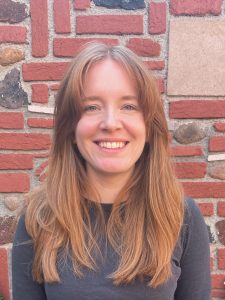 Keenan Hale started her role as Teacher Librarian at Fremont High School in Oakland, California, in 2024. Prior to working in libraries, she worked primarily as a Visual Art Teacher (with a short ELA/ELD detour) for six years. Keenan earned her B.A. in English and Visual Art from Mount Holyoke College, her M.A. in Education from Mills College, and is currently pursuing her MLIS from San José State University. She has been lucky enough to serve on multiple teams and has built a deep appreciation for collaborative and creative learning environments. When not planning/teaching/studying, she finds joy in reading, hiking with friends, and making art.
Interested in partnering with Lead by Learning to build the schools students need? Connect with a member of our team to learn more about our range of partnerships designed to reach your goals for student and adult learning.